Why Table Tennis Is Perfect for Social Play
Smatchy Team
6 min read
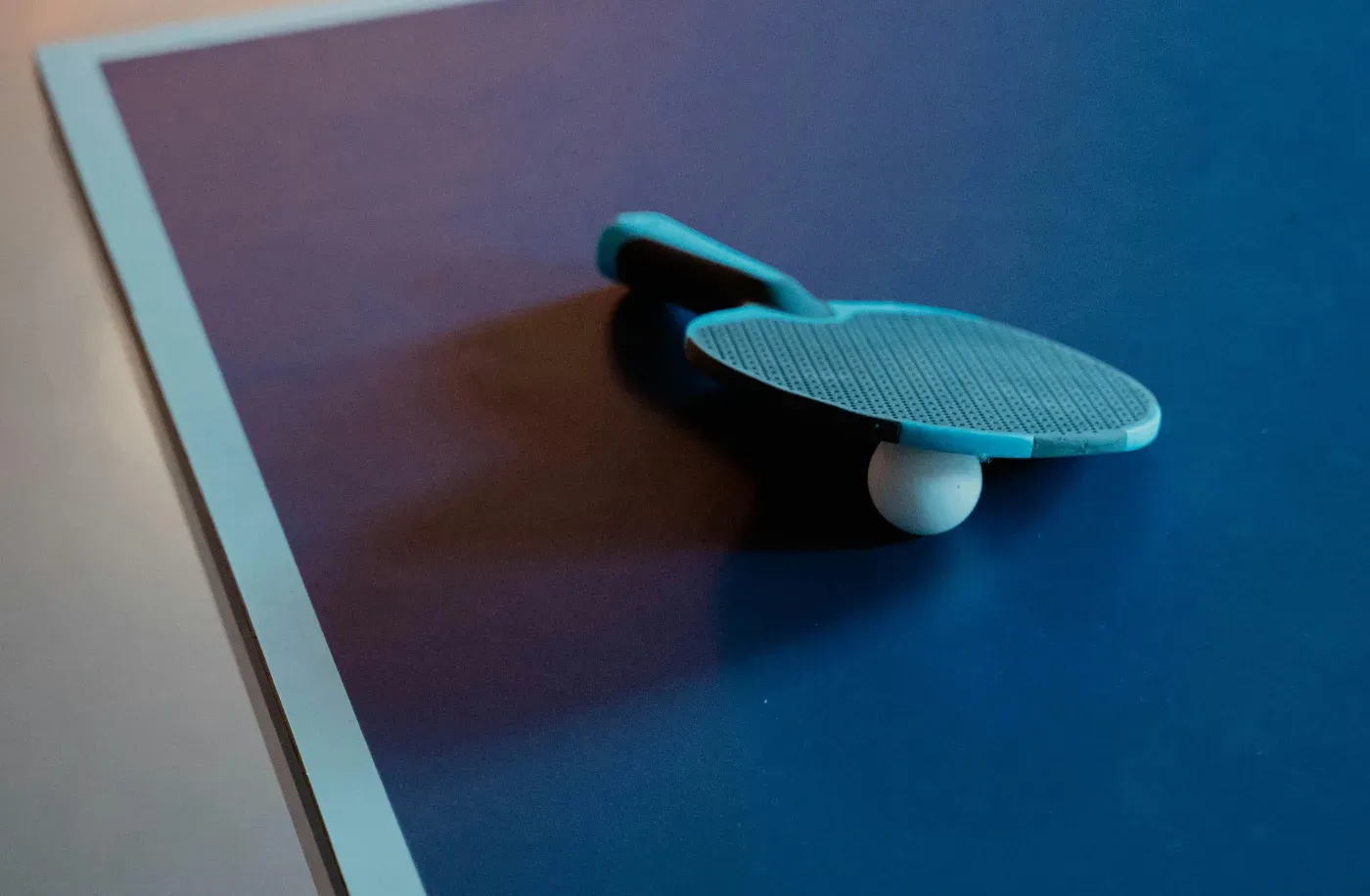
A table, two bats, a forty millimetre ball weighing two and seven tenths of a gram. Few sports ask for so little and give back so much. Table tennis has one rare quality: it puts you less than three metres away from someone you would probably never have met, it demands no special kit, no changing room, no slot booked six weeks in advance, and one mishit is all it takes for the conversation to start.
We see a lot of sports go by on Smatchy. Table tennis is the one where the distance between “I don’t know anyone here” and “same time Tuesday?” is shortest. Here is why.
Why does table tennis get going so quickly?
Most team sports impose an entry threshold. You need eleven people, or at least six. You need a pitch, a time slot, an existing squad willing to take you in. Until that threshold is cleared, you don’t play.
Table tennis has no such problem. You need two people. If there are four, you play doubles. If there are eight, you rotate. The delay between wanting to play and the first rally is measured in seconds, not weeks. That absence of friction changes the social nature of the sport completely: you don’t need to be expected somewhere in order to turn up.
Add to that the shape of the points. A rally rarely lasts more than a few seconds. Between two points there is a pause, short but real, and it is exactly in those gaps that people talk to each other. A game of table tennis is a hundred micro conversations threaded through the play itself. Try getting the same thing halfway through a swimming session.
How far apart are two table tennis players really?
A regulation table is two metres seventy-four long. Your partner therefore stands less than three metres from you, facing you, with no helmet, no padding, no background noise. You can see their face. You can hear them at normal speaking volume. You can tell whether they are enjoying themselves or getting annoyed.
That closeness is the ingredient most sports lose as they scale up. On a football pitch you spend most of the match thirty metres away from half your team. On a tennis court there are more than twenty metres between the two baselines. In table tennis, the geometry of the game forces you to look at the other person for an hour. That is not a small thing.
What happens in your brain during a rally?
Table tennis is not only a social pretext, it is also one of the most demanding sports there is for attention. The ball travels fast over a very short distance, which leaves little time to read the spin, decide and trigger the stroke.
A study published in PLOS One in July 2026 followed twenty-eight sports science students over eight weeks, half of whom took table tennis classes. The group that played improved its concentration scores by 12.65 per cent against 7.70 per cent for the control group, and its careful decision-making by 21.43 per cent against 0.96 per cent. The authors remain cautious: on a sample that small, the gap between the two groups does not reach the threshold of statistical significance. The progress made by the playing group, on the other hand, is clear.
Those results sit alongside an older body of work. A review published in the journal Encyclopedia brings together several studies showing that players over fifty score better on frontal lobe tests, that regular players have faster motor reaction times, and that playing goes hand in hand with higher reported life satisfaction. The authors explicitly connect that last point to the social dimension of the sport, not only to the physical effort.
Put differently, you don’t have to choose between seeing people and doing something serious for yourself. It is both, in the same hour.
Is table tennis open to every level?
Try the following experiment. Put a twenty year old and a sixty year old on a football pitch, then on a table tennis table. In the first case the physical gap decides the match before kick-off. In the second it decides almost nothing. Touch, placement and reading the spin count for more than raw speed, and those things are acquired over time.
The same goes across sexes, the same goes across body types. Table tennis is one of the very few sports where a mixed, cross-generational game between uneven levels stays interesting for everyone, provided the players agree to play for the sake of playing. An experienced player can simply return, vary the spin, keep the rallies going, and still get something out of it. On many other courts, that same imbalance ruins the session for both sides.
Is table tennis really picking up again in France?
The French Table Tennis Federation announced 254,110 licensed players for the 2024-2025 season, up 11 per cent, an all-time record. The signal is simple: there are more people than before who want to play near you, and many of them are looking for exactly what you are looking for, a regular partner rather than a competition.
To that figure you have to add everything that never gets counted. The tables in break rooms, on campuses, in municipal parks, the bats that have been asleep in a cupboard since the last house move. Table tennis is one of the rare sports where the number of actual players vastly exceeds the number of registered ones.
What really stops people from playing table tennis?
If table tennis is that accessible, why do so many people no longer play? The answer rarely has anything to do with the equipment or the venue. It has to do with the person on the other side.
That is precisely the problem we are trying to solve with Smatchy. You state your sport, your level, your availability and your area, and the app suggests players looking for the same thing at the same time. No ranking, no league, no year-long commitment. A partner for Thursday evening.
How do you find a table and partners this week?
Three moves are enough. First, find the nearest table to you, there is probably one in a municipal sports hall, a community centre or a park less than ten minutes away. Then set a realistic slot rather than an ambitious one, one hour a week actually kept is worth more than three hours abandoned in October. And above all, find the person on the other side before you find the slot, because they are the reason you will come back.
The rest, the backspin serve, the pivot backhand, the third ball, will come on its own. Nobody has ever quit table tennis because the technique was too hard. People quit because they have nobody left to play with.